Showing posts with label Cambodian Animals and Plants. Show all posts
Showing posts with label Cambodian Animals and Plants. Show all posts
21 March 2014


21 February 2014
Moment of Zen: Peaceful Elephants in Cambodia (Reprised)
The Wildlife Conservation Society presents camera trap footage revealing an intimate glimpse of Asian elephants in Seima Protection Forest, Cambodia. The stunning images were collected during biodiversity monitoring work by WCS and the Cambodian Government's Forestry Administration, and filmed by Daniel Morawska, WCS's Seima Management Advisor.
29 December 2013
30 October 2013
Cambodian Frog Trade (4)

Ugly but delicious.
That's the Truncate-snouted bullfrog (Glyphoglossus molossus). The bullfrog, Cambodia's 3rd most eaten frog after the Rugulose frog and the Paddy frog, is only found in the north-west of the kingdom.
Hidden under leaves, or well-burrowed underground for most of the year, this frog is easily hunted only after the first heavy rains when it makes itself known for the purpose of breeding.
Often fermented to preserve the meat in a similar way to the pungent, yet popular, Prahoc fish paste, the Truncate-snouted bulldog is exported in significant quantities to Thailand.
The Thais love of this frog has meant a 30% reduction of this bullfrog in Thailand and thus it has been designated as 'near-threatened.'
12 October 2013
Cambodian Frog Trade (3)

The most popular frog for eating in Cambodia, after the Rugulose or as it is also known the Chinese edible frog, is the Paddy frog. (Fejervarya limnocharis)
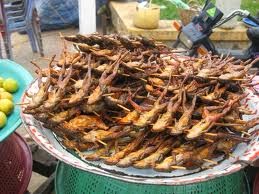
Its small size- it measures between 5 and 12 centimetres means its main appeal is as a snack to accompany alcohol. It's often this frog that is served skewered on a stick.
The paddy frog is not an endangered species and can be found in good numbers at any time of the year.
5 October 2013
Cambodian Frog Trade (2)

Found in rice paddies and other agricultural settings, its size, which can reach up to 125 millimeters, makes it popular on Cambodian villagers and city-dweller dining tables. It is often hunted using a wooden harpoon gun. This frog sells for about US$2 a kilo in the wet season and the price doubles in the the dry.
Cambodian Rugulose frogs are exported to both Vietnam and Thailand. Despite their popularity the frog is not considered endangered.
Cambodian Frog Trade (1)
2 October 2013
Cambodian Frog Trade (1)
 Frogs are an important source of protein for may rural Cambodians. And they appear on the menu of many Phnom Penh restaurants as well.
Easily caught after the first big rain of the season the frogs pass through several middle-men before arriving at city markets.
During the wet season approximately 2,500 kilograms of frogs are sold daily in the capital's markets. This figure can fall to less than 600 kilograms in the dry season.
Most frogs are caught at night- moonless nights provide the best hunting- snared in bamboo gill traps with fermented fish as the lure.
These traps typically hold 6-8 frogs with most trappers owning around 10 traps.
 |
Photo: www.garrisonphoto.com |
13 July 2013
The Samkos Bush Frog: Green Blood, Turquoise Bones
 |
| Photo by J. Holden FFI |
Meet the Samkos bush frog.
First formally identified in the Cardamom Mountains of Cambodia's south-west as late as 2007 this frog is considered extremely rare.
However, with little known about the Samkos (Chiromantis samkosensis) it's conservation status is classified as data deficient.
The Samkos:
~ has green blood.This is the result of waste product processed in the liver then passing through the blood.
~It's possible this green blood is unpalatable and thus protects the frog from predators.
~It's bones are turquoise in colour.
~The male has a distinctive rising thrill. Without such a call this tiny (less than one-inch), well-camouflaged frog, would be all but impossible to find.
~A subsequent expedition to look for more frogs largely failed- only one was found- as a breeding pond where they were first discovered had been filled, in preparation for a new road.
27 June 2013
New Bird Species Discovered Within Phnom Penh
 |
| The Cambodian tailorbird, a small bird, which has a black-feathered throat and is the size of the more common wren, which lives in thick, lowland scrub in Phnom Penh and other sites in the nearby floodplain. Photograph: James Eaton/AFP/Getty Images |
A shy bird that confines itself to dense scrub the Cambodian Tailorbird will likely be categorized as 'Near Threatened,' by the International Union for Conservation of Nature.
8 June 2013
Cambodia's National Fish: The Giant Mekong Barb

Such is the size of Cambodia's national fish, its scales are used to make many of the shuttlecocks that Cambodians across the country use in their popular 'kick and keep-it-up' game.

The Giant Mekong Barb (Catlocarpio siamensis) known by the Khmer as Trey Kahor or Trey Kbal Lan or Trey Koalreang, can weigh in at 300 kilograms and reach 3 metres in length.
Grey and silver in colour, this giant fish is found in the Tonle Sap lake and the Mekong river.

It's makes for good eating; they have been served on Cambodian dinner plates for hundreds of years and they appear in the Bas Reliefs of Angkor Wat.
Hatcheries and breeding stations are being used to keep Cambodian waters well-stocked with their national fish.
See also: Cambodia's national mammal.
Cambodia's national flower
Cambodia's national fruit
Cambodia's national reptile
27 April 2013
27 February 2013
Cambodia's National Mammal: The Kouprey (Reprised)

The Kouprey is Cambodia’s National Mammal.
But it’s
unlikely that you have ever seen one. Or that you ever will. That’s because they are categorized by
the International Union for the Conservation of Nature (IUCN) as a ‘critically
endangered species, possibly extinct.*’
This wild ox, should it still exist, would likely be found in Cambodia’s most northern forests and, now improbably, in southern Laos, the west of Vietnam and in Thailand’s eastern provinces.
The ox measures in at a length of between
210 and 225 cm with a shoulder height of 170-190 cm. It weighs somewhere
between 680 and 910 kg and it's distinguished by a set of fine horns (up to 80cm
for the male and 40 cm for the female) and a mighty dewlap. (That’s the loose
skin hanging from the throat)

Kouprey means ‘Forest bull’ in Khmer and it
was designated Cambodia’s National Mammal by Prince Sihanouk in the 1960’s.
The last sighting of this fine beast was in
1988, thus it seems improbable that the Kouprey continues to survive.
* This rather odd classification is because
extensive surveys are carried out before a species is named as extinct.
See also: Cambodia's National Flower
http://cambodianbeginnings.blogspot.com/2012/10/cambodias-national-flower.html
And: Cambodia's National Fruit
http://cambodianbeginnings.blogspot.com/2012/12/cambodias-national-fruit-chicken-egg.html
And: Cambodia's National Reptile
http://cambodianbeginnings.blogspot.com/2013/02/cambodias-national-reptile-royal-turtle.html
17 February 2013
Cambodia's National Reptile: The Royal Turtle
 |
| Photo: http://blogs.scientificamerican.com |
Many Cambodians believe that this reptile is the sole property of their king. Thus, captured turtles are often adorned with flowers and coloured powder while monks preside over peace and prosperity prayers. The Royal turtle is then released.
This critically-endangered turtle, known as 'Andoeurk Sarsai' or 'Andoeurk Lung' by the Khmer is found only in small parts of Malaysia, Indonesia and Cambodia. Just ten of these turtles were believed to be living in the wild in Cambodia in late 2011. Only 200 exist elsewhere in the wild.

However, with a captive breeding program proving successful with 100 juvenile turtles hatched in the small town of Sre Ambel, in Koh Kong province, and another hatching facility being built in Siem Reap, the long-term future of the Royal turtle is thought to be bright.
A satellite tracking program was launched a year ago with the progress of a female adult being tracked in the Sre Ambel river. (See Video below)
See also:
20 January 2013
Slightly Interesting Cambodian Facts (14) Freshwater Fish
 |
| The Channa marulius or Great Snakehead |
Number of species of freshwater fish found in Cambodian waters?
490.
Of these, 462 are native to the kingdom.
 |
| Polynemus melanochir dulcis or the Lake Blackhand Paradise Fish |
The other 27 fish were either introduced or of 'questionable' origin.
8 December 2012
Cambodia's National Fruit: Chicken Egg Banana
 |
| Chicken Egg Bananas, far-left and centre |
By Royal decree the Chicken Egg banana was named the national fruit of Cambodia by King Sihamoni on the 25th March, 2005.
The Chicken Egg banana is tiny as it measures in at just 4-5 inches, but sweeter than other bananas it makes for an excellent dessert.
It's popularity extends further than for eating though; its cheap and this means everyone can use it regularly as an offering to the spirits or at Buddhist ceremonies.
6 November 2012

31 October 2012
Slightly Interesting Cambodian Facts (5) Cambodian Seahorses
 |
| Cambodian Seahorses under -threat |
12 October 2012
Cambodia's National Flower

The plant can grow up to 12 metres tall and its distinctive fragrance can be detected from a distance. The Rumdul produces clusters of edible crimson fruit.
9 October 2012
Slightly Interesting Cambodian Facts (2) Rice Consumption

Cambodians eat, on average, 152 kilograms of rice a year.
That makes them the world's 6th top consumer of rice per capita.
Brunei heads the world's rice-eating list list with its citizens plowing their way through 245 kilograms of the grain. They are followed by the Vietnamese (166kg), the Laotians (163kg), the Bangladesh (160 kg), and the Burmese who chow down on 157 kilograms of rice.
~Source:http://www.irri.org
17 July 2012
The Cambodian Kukri
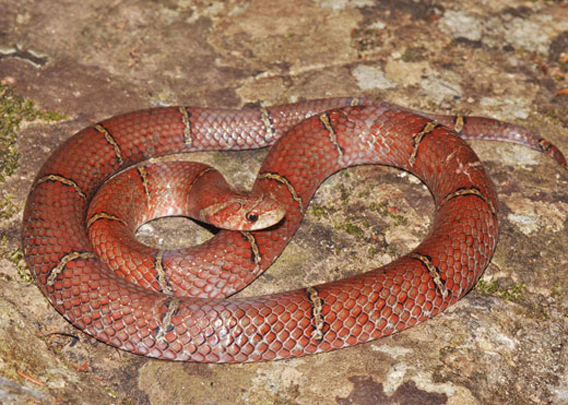
Flora and Fauna International have announced the discovery of a new snake- the Cambodian Kukri.
Found in Cambodia's South-West Cardamom Mountains, this Kukri has curved rear fangs that allow it to puncture eggs, and it's striking black and white stripes set against a primarily rust-red skin make for a beautiful snake.
Subscribe to:
Posts (Atom)